We research every product we recommend. We may earn a commission from the links on this page.
Electronics › Power Strips

Surge Protectors Fail Without Warning — Here’s What Actually Wears Out

We compare published specifications and marketplace data. We do not test these products.

Your Surge Protector Stops Protecting Long Before It Stops Working
Photo by ready made on Pexels

A 900-joule surge protector can absorb exactly that — 900 joules — spread across every voltage spike it ever encounters. One bad storm might spend half that budget in a second. A dozen small transients from your HVAC cycling on and off chip away at the rest over months. When the protection is gone, the strip keeps passing power like nothing happened. Your laptop charges. Your monitor turns on. The only thing missing is the part you bought it for.

Affiliate disclosure: This article contains affiliate links. We may earn a commission if you buy through them, at no extra cost to you.

Everything we looked at
4 picks

How we picked

We do not plug in or test these strips. Judgments rest on published joule ratings, component-grade markings, and aggregated marketplace feedback.

Stated joule budget, not outlet count

Protection capacity in joules determines how many surges the strip can absorb before it becomes ordinary extension cord wiring.

Component ratings, not brand promises

MOV grade and thermal cutoff specifications reveal whether the internal circuitry matches the protection claims on the box.

Form factor against real placement

Flat plugs, desk clamps, and cord length solve the physical problems of wall clearance and furniture access that spec sheets ignore.

Charging speed vs. surge role

High USB wattage answers a different job than voltage spike absorption — one strip rarely optimizes both without compromise.

The Part That Burns Out Is the Point

Inside every surge protector sits at least one metal oxide varistor — a small disc made of sintered zinc oxide. Under normal voltage, it acts like an open switch. When voltage spikes past a threshold (typically 330 to 400 volts on a 120V circuit), the MOV’s resistance drops almost instantly, shunting the excess energy to ground instead of letting it reach your devices.

That shunting isn’t free. Each surge physically degrades the zinc oxide grain boundaries inside the MOV, creating permanent conductive paths that lower its clamping voltage. A varistor that started clamping at 330V might drift down to 300V after absorbing a few hundred joules. Eventually it can’t clamp at all.

The joule rating on the box is a lifetime number, not a per-event number. A 1500J rating means the MOV can absorb 1,500 joules total — whether that arrives as one catastrophic spike or a thousand small ones from appliances cycling. Once it’s spent, the strip passes power normally but offers zero protection. Some units include an indicator LED that goes dark when protection is lost. Most cheap ones don’t.

Why Two of These Strips Don’t Tell You Their Budget

Of the four strips here, two publish a joule rating and two don’t. That’s not a minor omission — it’s the difference between knowing your protection has a measurable lifespan and having no way to evaluate it at all.

A strip without a stated joule rating might still contain an MOV. It might even be a decent one. But without a number, you can’t compare its absorption capacity to anything, and you can’t make a reasonable guess about when to replace it. You’re trusting the manufacturer’s decision not to tell you.

This matters because MOV degradation is cumulative and invisible. A strip rated at 900 joules in a home with frequent small transients — old wiring, a big compressor on the same circuit, an elevator motor in a nearby building — might exhaust its protection in two years of normal use without a single dramatic storm. A 1500-joule unit on clean power in a newer building lasts longer, not because it’s better built but because it has more material to burn through before the same endpoint.

Joules vs. Watts vs. USB Wattage: Three Different Numbers

Surge protector packaging mixes three unrelated measurements, and confusing them leads to bad purchases.

Joules measure total surge absorption capacity — the MOV’s lifetime energy budget. Higher is better, and it depletes over time. This is the protection spec.

Wattage ratings like 1250W describe how much continuous power the strip can safely pass through to your devices. A 1250W strip on a 120V circuit handles about 10.4 amps. That’s the load limit for normal operation, not surge protection. You’d hit this limit by plugging in a space heater and a hair dryer simultaneously, not during a lightning strike.

USB wattage — 65W, 70W — describes the charging output of the strip’s built-in USB ports. A 70W USB-C port can fast-charge a laptop. A 5W USB-A port trickle-charges a phone. Neither number has anything to do with surge absorption. A strip can deliver 70W of USB charging power while providing zero joules of surge protection, or 1500 joules of protection with only 5W USB output.

When a product prominently advertises 65W GaN charging, that’s a USB feature. It tells you nothing about what happens when a voltage spike arrives on the AC line.

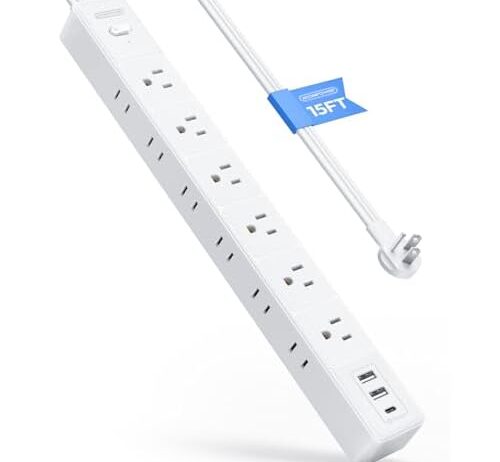
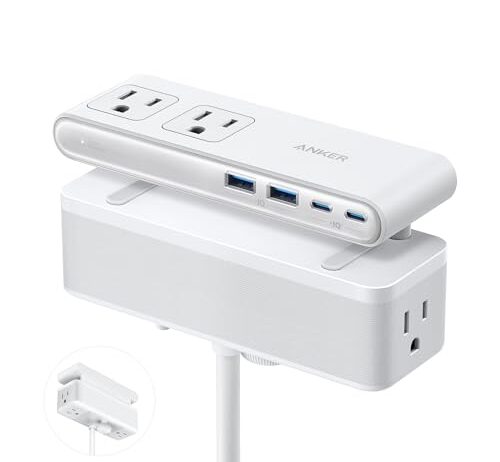
At 1500 joules, this Anker strip has roughly 67% more absorption capacity than the 900-joule TESSAN. In practical terms, that means more headroom before the MOV degrades to uselessness. If your home experiences frequent small transients — the kind you never notice because they’re over in nanoseconds — that extra capacity translates directly into a longer protection lifespan.

The desk-clamp mounting is worth noting for a reason beyond tidiness. Surge protectors on the floor collect dust, and dust plus heat from an MOV absorbing energy is exactly the combination thermal fuses are designed to interrupt. Clamped to a desk edge, the strip gets better airflow and stays visible — you’re more likely to notice if a protection indicator LED goes dark when the unit is at eye level rather than buried behind a filing cabinet.

The two USB-C ports deliver up to 70W combined, which is enough to fast-charge a laptop without a separate brick. That’s a charging convenience feature, separate from the surge protection — but having fewer adapters plugged into the AC outlets means fewer devices competing for the strip’s 120V pass-through capacity.

More Outlets Don’t Split the Protection

A common worry: does plugging twelve things into a twelve-outlet strip mean each device gets one-twelfth of the surge protection? No. MOVs don’t work that way.

The varistor sits between the hot wire and ground (and sometimes neutral), upstream of all the outlets. When a surge arrives, the MOV clamps the voltage for the entire strip at once. Every outlet behind it sees the same clamped voltage regardless of how many are in use. The joule rating is a lifetime budget for the MOV itself, not a pool divided among connected devices.

What more outlets do affect is the strip’s total current draw under normal operation. Twelve outlets each pulling a moderate load can approach the strip’s amp rating faster than three outlets doing the same. That’s a fire-safety and breaker-trip concern, not a surge protection concern. The protection circuit doesn’t know or care how many outlets are populated.

The 900-joule rating is lower than the Anker’s 1500, but the fact that it’s stated at all puts it ahead of the two strips that publish no protection spec. You know what you’re getting, and you can make a reasonable replacement schedule — in a home with average transient activity, 900 joules might last two to four years before degradation reaches the point where protection is nominal.

The flat plug design solves a specific problem: standard plugs stick out perpendicular to the wall, which means you lose several inches of clearance behind furniture. A flat plug sits nearly flush, so a desk or bookshelf can push closer to the wall. It’s a small thing until you’re trying to fit a surge protector behind a nightstand in a bedroom where every inch of floor space matters.

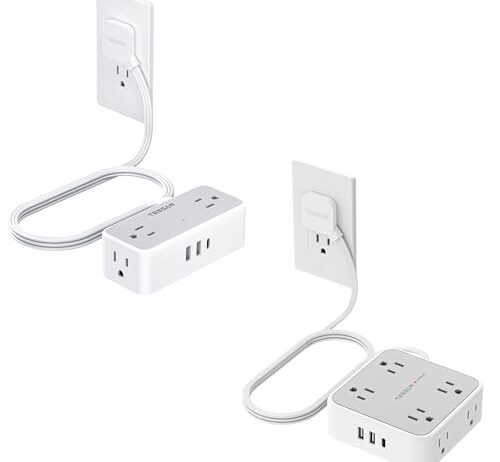
The three-sided outlet arrangement spreads the receptacles across multiple faces of the strip, which reduces the chance of a bulky adapter blocking an adjacent outlet. A wall-wart phone charger that covers two slots on a linear strip only blocks one direction on a three-sided layout. At 1250W pass-through capacity, this strip handles typical home-office loads — monitor, laptop charger, desk lamp, phone charger — without approaching its limit.

When GaN Charging Meets Missing Protection

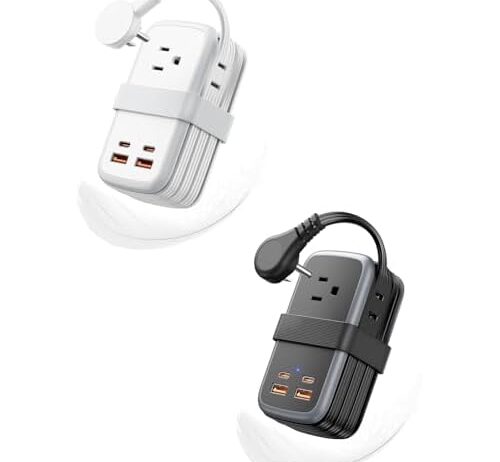
Gallium nitride semiconductors switch faster and waste less energy as heat than traditional silicon transistors at the same power level. That’s why a 65W GaN charger fits in a package the size of a standard 30W adapter. It’s real technology doing a real thing — for USB charging.

But GaN has nothing to do with surge protection. The GaN components sit in the DC charging circuit that converts AC power to the 5V/9V/20V output your phone or laptop needs. The surge protection circuit — if one exists — sits upstream on the AC side, using a completely separate MOV component. A strip can have cutting-edge GaN charging and no surge protection at all, which is exactly what an unrated strip with GaN features gives you: fast USB output with unknown protection.

This isn’t a knock on GaN. It’s a clarification about what it does and doesn’t do. If you need fast USB charging for travel, GaN density matters. If you need surge protection for a home office full of expensive electronics, the joule rating matters. They’re independent features that happen to share a housing.

Replace It Before It Tells You To (Because It Won’t)

The most dangerous failure mode of a surge protector is the silent one. The MOV degrades to zero absorption capacity, the strip continues passing power normally, and the next surge reaches your connected devices with nothing in the way.

Higher-end units include a protection status LED — a small light that stays lit while the MOV is functional and goes dark when it’s exhausted. Some go further with an auto-shutoff circuit that disconnects power entirely when protection fails, forcing you to notice. But basic strips, especially inexpensive ones, provide no indication at all.

A practical replacement schedule depends on your joule rating and your environment. In a home with reasonably clean power — newer wiring, no heavy industrial equipment nearby, grid-connected in an area with infrequent storms — a 1500-joule strip might last five or more years. In an older home with a window air conditioner, a refrigerator compressor, and a sump pump all on circuits that share a panel with your office, the transient load is higher and replacement should come sooner. After any event where you know a significant surge occurred — a lightning strike nearby, a transformer blowout, a sustained brownout — replace the strip regardless of its age.

FAQ

How do I know when my surge protector needs to be replaced?

Check for a protection status LED — if it’s gone dark, the MOV is exhausted and the strip is just passing power with no protection. If your strip has no indicator, replace it after any known surge event (nearby lightning strike, transformer failure, prolonged brownout) or every three to five years as a precaution, since small transients from appliances degrade the MOV over time even without dramatic storms.

Can a surge protector fail without me knowing?

Yes, and this is the most common failure mode. Once the MOV inside degrades past its absorption limit, the strip continues delivering power normally — lights work, devices charge, nothing beeps. Only strips with a protection indicator LED or an auto-shutoff circuit will signal that protection has been lost. Basic models give no warning at all.

What’s the difference between wattage and joule ratings?

Joules measure how much surge energy the strip can absorb over its entire lifetime — it’s the protection spec. Wattage (like 1250W) measures how much continuous power the strip can safely pass through to your devices during normal use — it’s a load capacity spec. A USB wattage rating (like 65W or 70W) describes charging output only. These three numbers are independent of each other.

Do surge protectors wear out even without a power surge?

They can. Small voltage transients — from a refrigerator compressor kicking on, an elevator motor starting, or HVAC cycling — generate minor spikes that the MOV absorbs routinely. Each one burns a small amount of the joule budget. In a home with older wiring and several large appliances, these micro-surges can exhaust a lower-rated strip over a few years without a single dramatic event.

Should I replace my surge protector after a lightning storm?

If lightning struck nearby and your power flickered or devices reset, yes. A close lightning strike can send a surge large enough to consume a significant portion of the MOV’s joule budget in one event — potentially all of it. Even if everything still works afterward, the protection component may be spent. Replacing the strip is cheaper than discovering it failed during the next event.

Do more outlets mean less protection per device?

No. The MOV clamps voltage for the entire strip at once, upstream of all outlets. Every connected device sees the same protected voltage regardless of how many outlets are populated. More outlets do increase total current draw under normal use, which affects the strip’s amp rating and breaker-trip risk, but that’s a separate concern from surge absorption.